Yukon Territory, Canada
Aben Gold holds a 100% interest in the 7,400-hectare Justin Gold Tungsten Project. The property lies within the prolific Tintina Gold Belt (specifically the Tombstone Gold Tungsten Belt), approximately 25 kilometres southwest of the past-producing Cantung Tungsten Mine and adjacent to Seabridge Gold’s 3 Aces Project.
An all-season road runs through the claims, providing excellent access. The Justin Project hosts multiple zones of intrusion-related gold mineralization as well as significant tungsten potential. Aben is currently assessing high-grade historical tungsten results from its 2014 re-assay program and is actively planning a comprehensive 2026 exploration program that will simultaneously target both gold and tungsten to unlock the full multi-metal potential of the property.
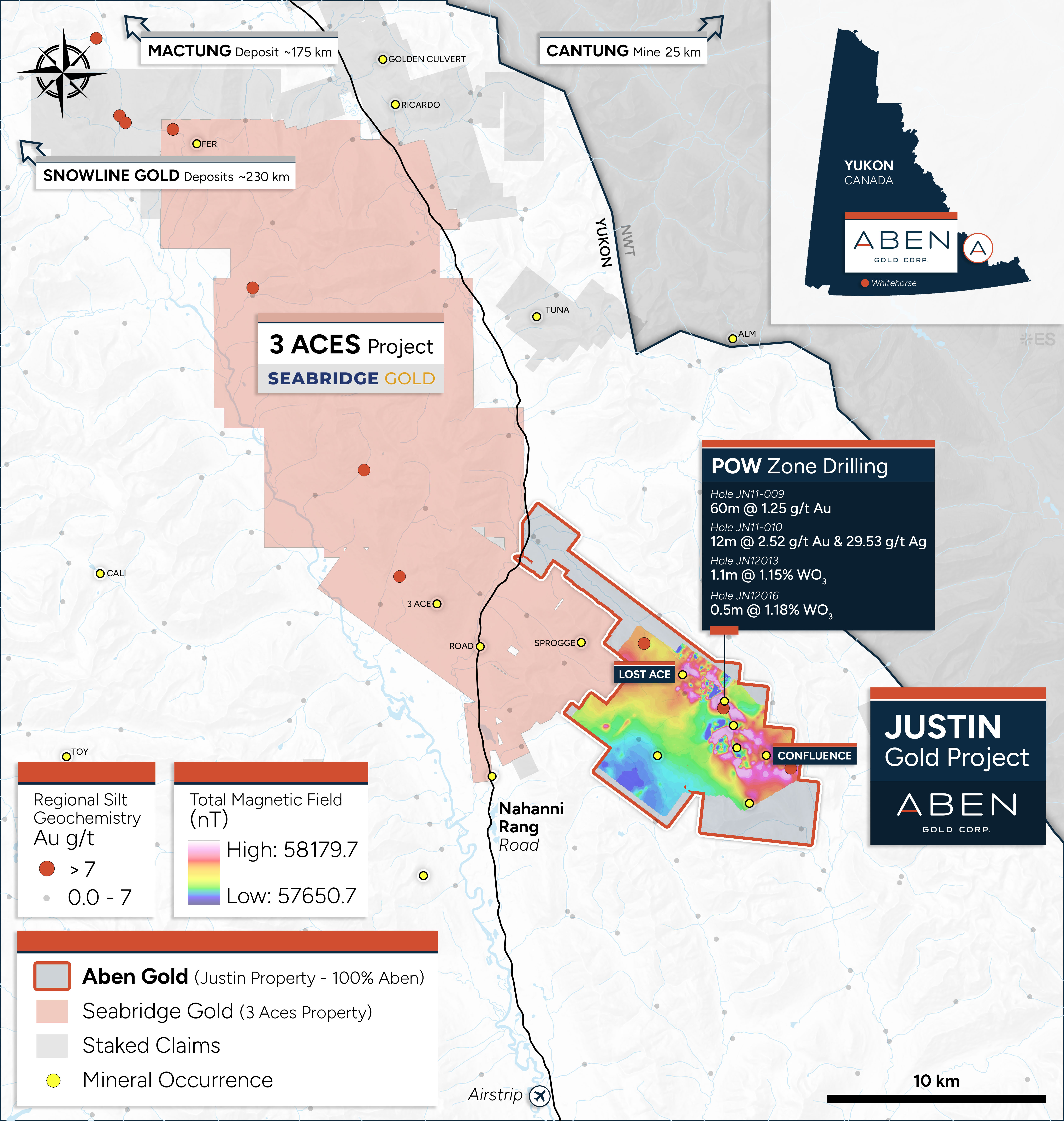
Exploration work at the Justin Gold Project began back in 2010 and Aben has been actively working at the site with positive exploration results. Click to enlarge the map.
Exploration Activity
- Class 1 Quartz Approval (November 2025) and 5-year Class 3 Quartz Approval (May 2026): Received from the Liard First Nation, Ross River Dena Council, and the Government of the Yukon. This approval enables exploration and diamond drilling activities for the planned summer 2026 field program.
- 2024 QMAGT Airborne Geophysical Survey: A state-of-the-art airborne magnetic gradiometry (QMAGT) survey was flown over the Lost Ace and POW zones as well as the highly prospective area between them. Finalized results identified coincident geophysical and geochemical anomalies in under-explored areas, highlighting potential for expanded mineralization and a possible connection between the two main mineralizing systems.
- 2019 Exploration Program: Completed 20 rotary air-blast (RAB) holes totalling 592 m at the Lost Ace Zone to evaluate high-grade near-surface gold mineralization, along with 4 diamond drill holes totalling 963 m at the POW Zone.
- 2026 Exploration Program: On August 8, 2026, the first diamond drill program commenced since 2012. The Company is ahead of schedule to complete the 1,300 metre 2026 drill program. News Release: August 10, 2026
Justin Project, Yukon Geochemistry Compilation Map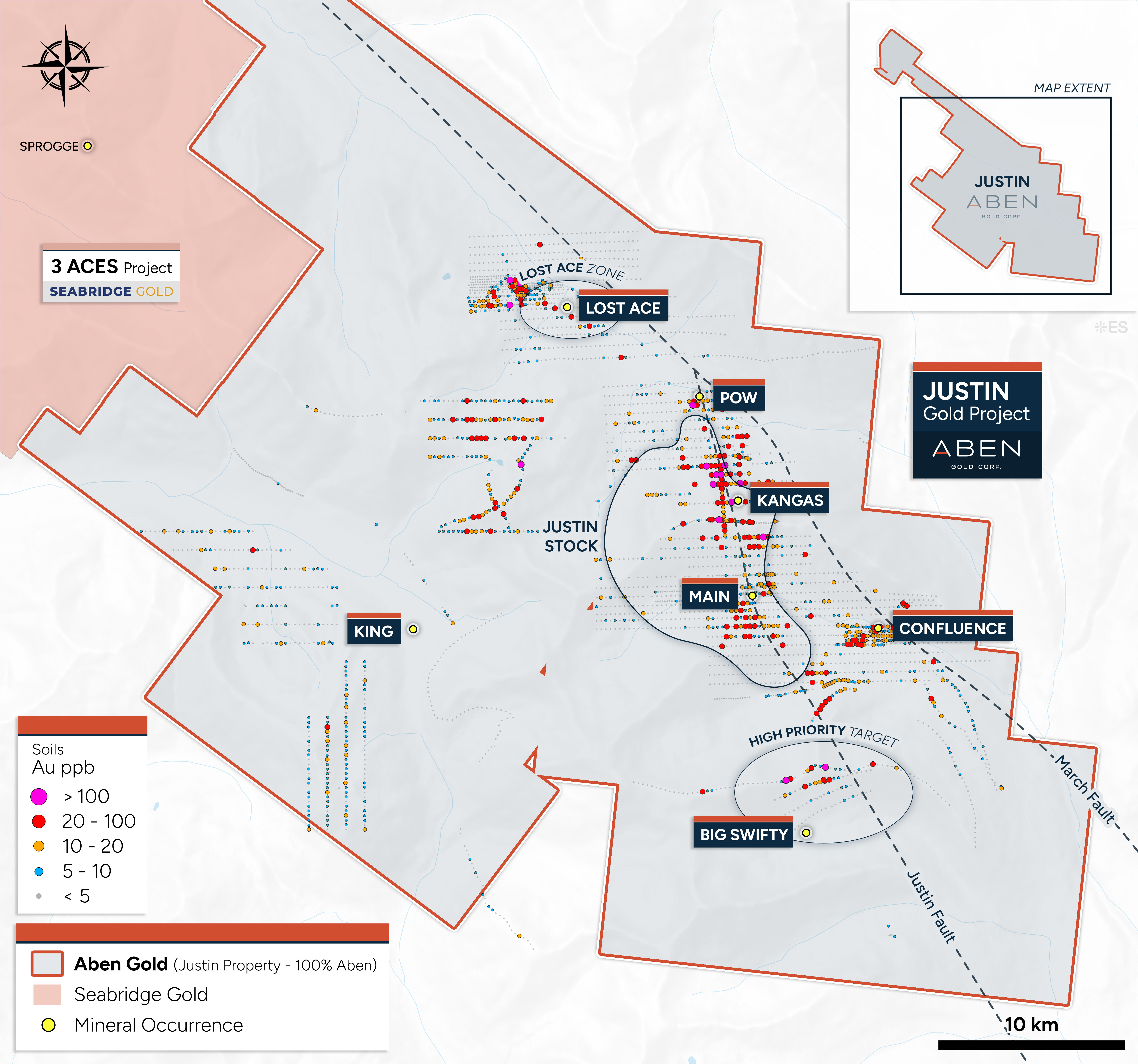
Key Zones
POW Zone – Gold + Tungsten Potential
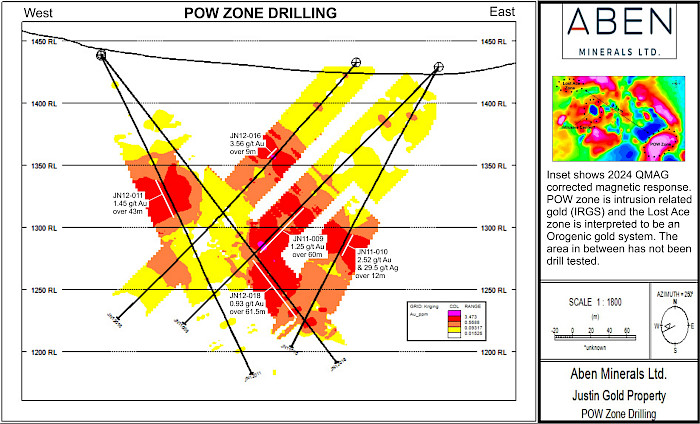
The POW Zone hosts intrusion-related gold system (IRGS) mineralization featuring skarn-style replacement and quartz-calcite stockwork veining. Diamond drilling in 2011 and 2012 returned strong gold intercepts that remain open in all directions. In 2014, tungsten-specific re-assays (WO₃) were performed on 230 drill core samples after visible scheelite was identified. Several high-grade tungsten intervals were returned, many of which are coincident with prior gold mineralization.Selected 2014 Tungsten Re-Assay Highlights (POW Zone):
- Hole JN12016: 8.50 metres @ 0.39% WO₃ (including 1.00 metre @ 1.12% WO₃), coincident with prior gold mineralization of 5.60 metres @ 4.12 g/t Au
- Hole JN12013: 28.90 metres @ 0.10% WO₃ (starting near surface) plus 1.10 metres @ 1.15% WO₃, also carrying prior gold values of 7.40 metres @ 1.81 g/t Au
- Hole JN11010: 12.00 metres @ 0.25% WO₃
- Hole JN12019: 7.20 metres @ 0.27% WO₃
Selected Gold Intercepts (POW Zone):
- JN11009: 60.00 metres @ 1.19 g/t Au (including 21.00 metres @ 2.47 g/t Au)
- JN11010: 11.30 metres @ 2.70 g/t Au and 29.0 g/t Ag
- JN12013: 7.40 metres @ 1.81 g/t Au (including 2.20 metres @ 4.42 g/t Au)
The tungsten results referenced above are historical in nature. A Qualified Person has not completed sufficient work to verify these historical assay results as current. The Company is not treating the historical tungsten results as current mineral resources or mineral reserves.
Lost Ace Zone
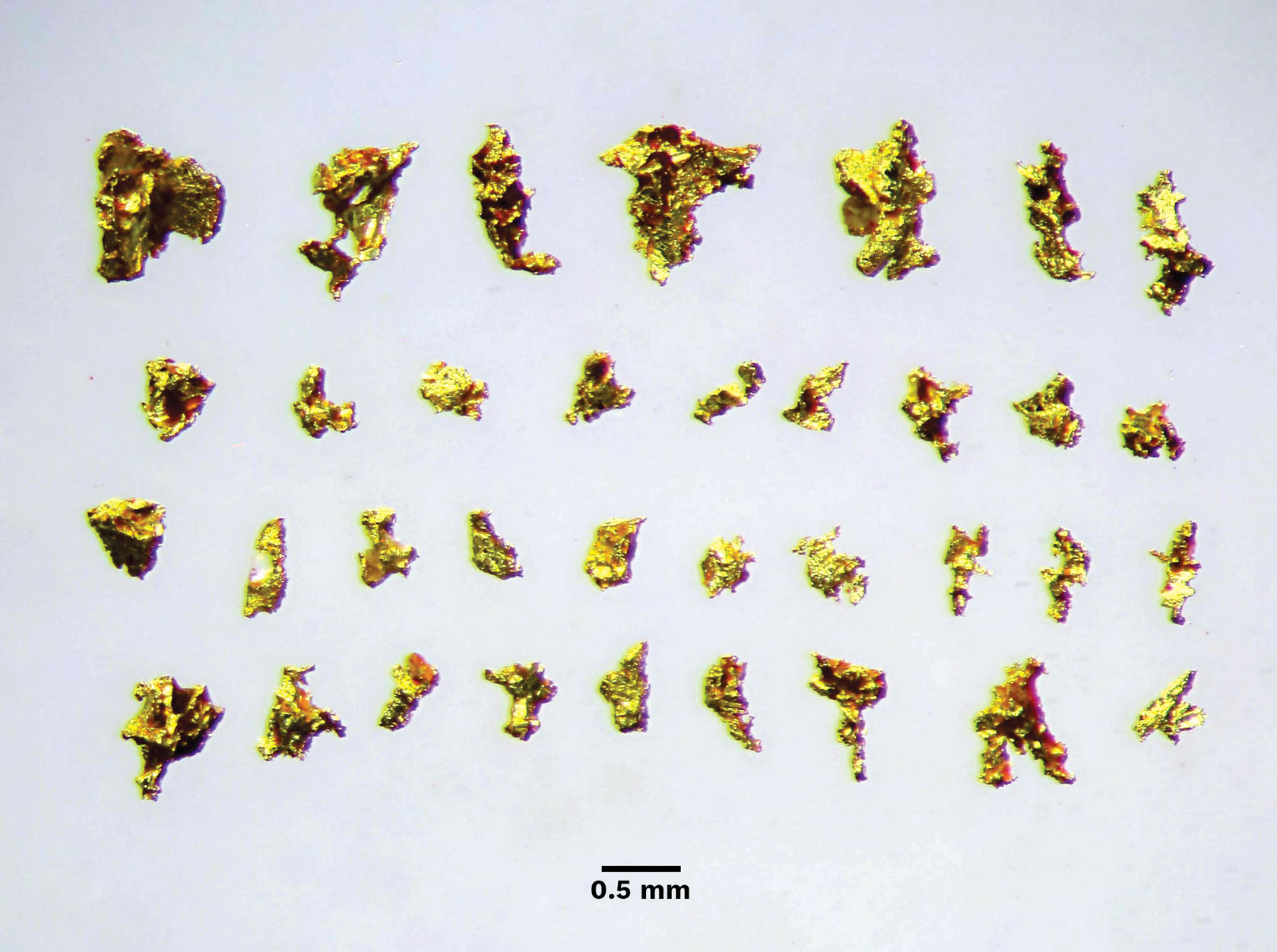
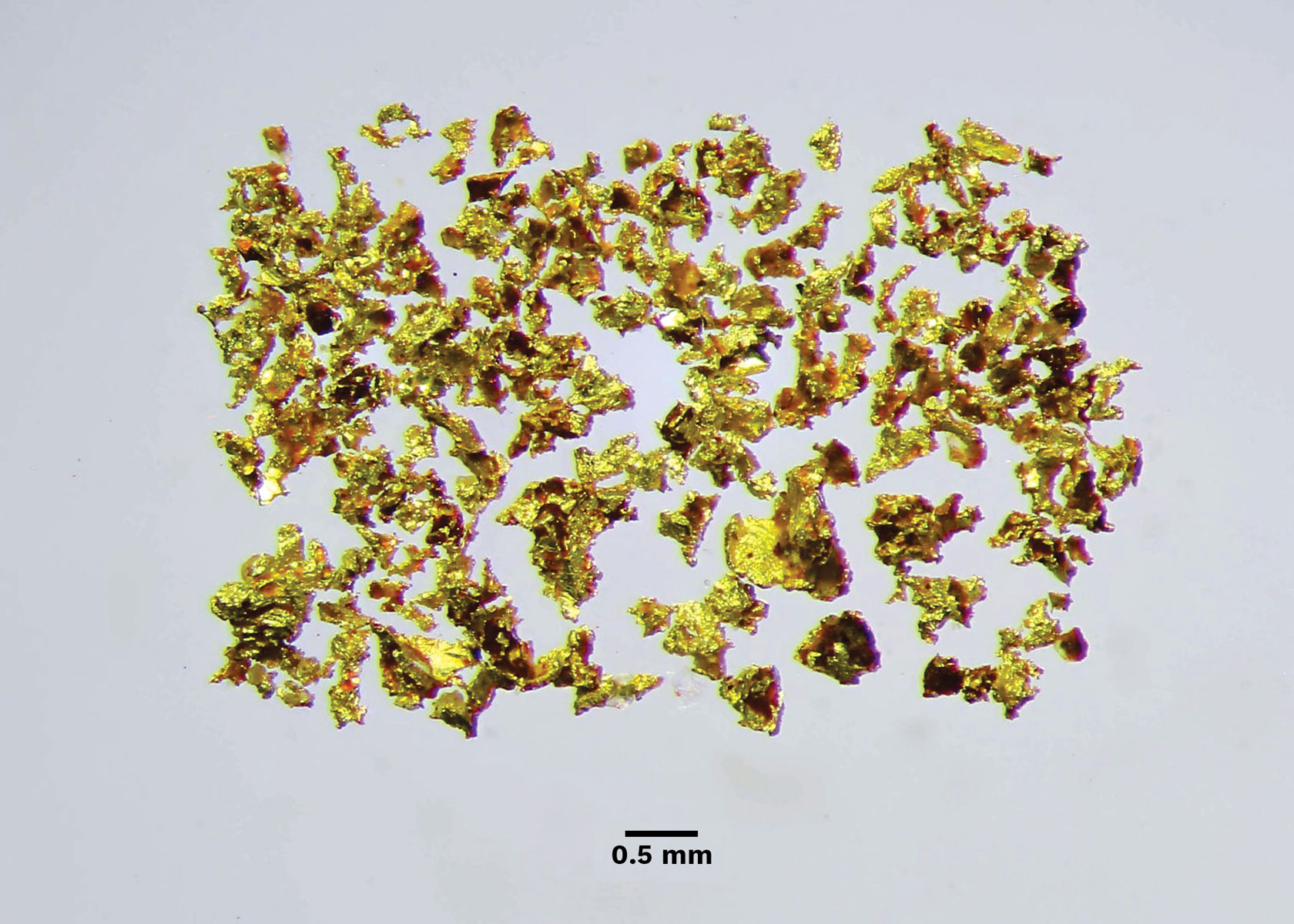
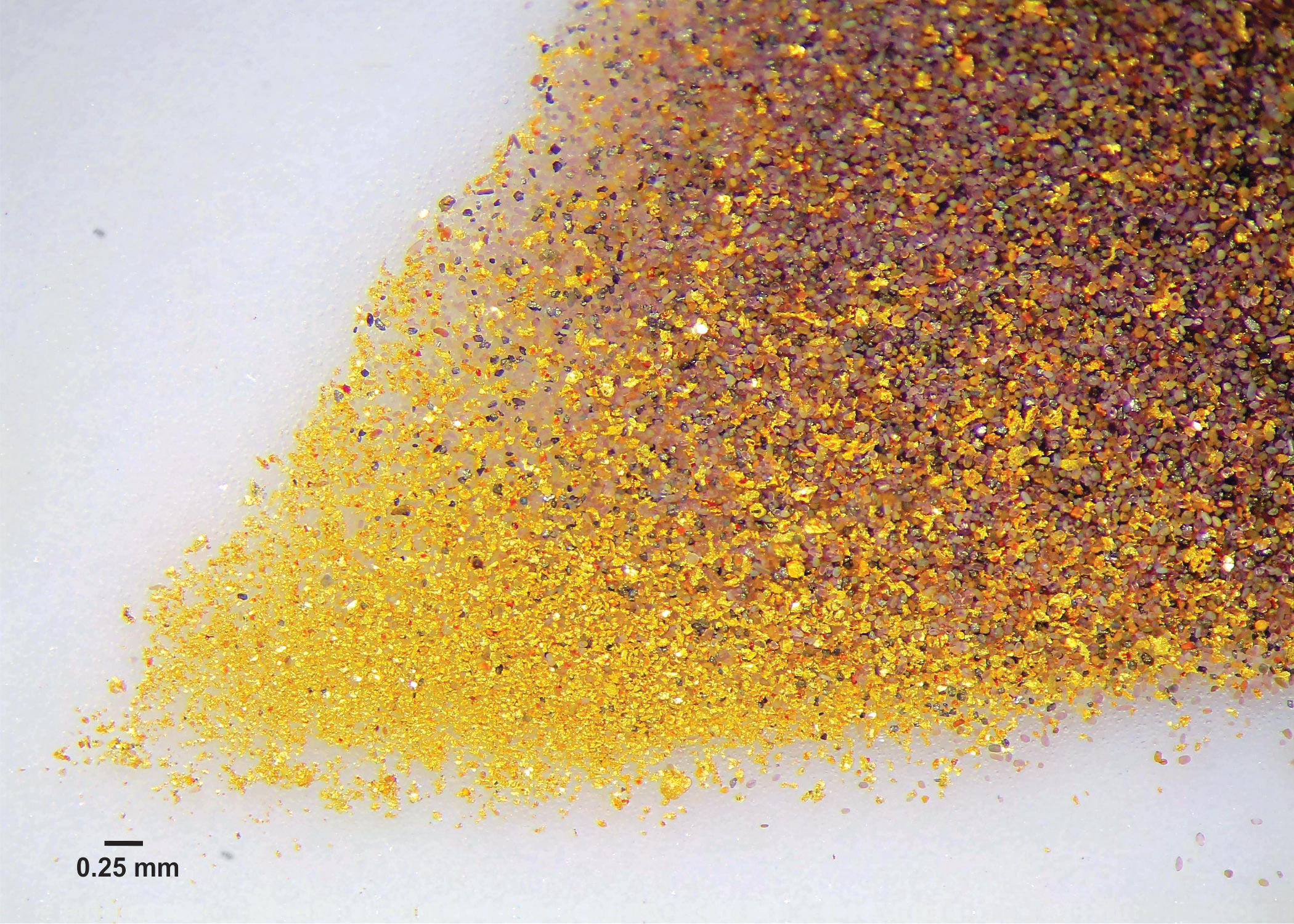
An orogenic-style quartz-gold bearing zone was discovered in 2017 and is located approximately 2 km west of the POW Zone. Channel sampling returned high-grade gold values, including 20.8 g/t Au over 4.4 metres (including 88.2 g/t Au over 1.0 metre). A bulk soil sample from the zone contained 1,135 visible gold grains, the majority of which were pristine, indicating a proximal bedrock source. The 2019 RAB drill program further tested the near-surface high-grade gold mineralization at this zone.
Gold Grain Sample (click image to enlarge)
Past Exploration Summary
- 2010–2011: Airborne geophysics, soil/rock sampling, and first diamond drill program (2,020 m in 10 holes) that discovered the POW Zone.
- 2012: Follow-up drilling at POW Zone.
- 2014: Tungsten-specific re-assay program on historical core.
- 2017–2018: Discovery and trenching at Lost Ace Zone; additional geochemical sampling.
- 2019: 20 RAB holes (592 m) at Lost Ace Zone
- 2024: QMAGT airborne geophysical survey over the main mineralized zones and intervening ground.
Past Exploration
In 2011, a Phase I 2,020 metre diamond drill program consisting of ten drill holes was completed on the Justin Property. The drill program was designed to assess the potential mineralization at the POW, Confluence, Kangas and Main zones. The drilling was the first ever completed on the POW, Confluence and Kangas zones. The 2011 activities represent the first systematic drilling campaign on the project since a small four hole program was completed on the Main zone in the mid-1980’s.
2026 Exploration Plans
Aben Gold is advancing a multi-metal exploration program at Justin that will test and expand both gold and tungsten targets. The work will focus on the POW Zone (gold + tungsten) and the Lost Ace Zone, with additional evaluation of other high-priority prospects identified by previous geophysical and geochemical surveys (including the 2024 QMAGT survey). The program is fully supported by the recently received Class 1 and Class 3 Quartz Approvals.